Thursday, December 4, 2008

Pronunciation

One of the biggest difficult I have in spoken english is the TH sound. As it does not exist in italian language, I have an huge problem to pronunce that sound correctly. As far as I know, it does not exist any italian word containing "th". Therefore, my tongue and palate are not accustomed to utter it. It goes often a T sound from my mounth.
There are many words over this section I would collect, read, learn and teach to someone else as well as I can. Some of those are:

Thesaurus: / θɪˡsɔːrəs / a dictionary of symonyms and antonyms.
Thick: / θɪk / relatively great in extent from a surface to the opposite. Antonyms: thin.
Thievishness: / ˡθiːvɪʃnɪs / characteristic of a thief; stealthy.
Thorough: / ˡθʌrə / executed without negligence or omissions.
Thoughtful: /ˡθɔːtfʊl/ occupied with or given to thought.
Thrift: / θrɪft / wise economy in the management of money and other resources.

Here there is a good website in which is described the way to say "th".
I have chosen just few words which start with this (for me) unpronunceable sound; all of them have the same phonic cadence.
On the other hand, there are some words changing just for the first letter, which are pronunced one differently from the other. For instance:

Cough: /kɒf/ an illness characterized by frequent coughing.
Bough: /baʊ/ a branch of a tree, esp. one of the larger or main branches.
Dough: /dəʊ/ flour or meal combined with water, milk, etc., in a mass for baking into bread, cake, etc.; paste of bread.
Rough: /rʌf/ having a surface marked by irregularities, protuberances, or ridges; not smooth.
Tough: /tʌf/ strong and durable; not easily broken or cut.

I have to be careful to remember these sounds above. The only way to achieve a good TH sound and a great and well pronunciation is speaking. The more you speak, the better is your english.
Reference: the words' meaning has been found out on http://dictionary.reference.com/

Wednesday, December 3, 2008

Understanding plagiarism and referencing

"Plagiarism: the unauthorized use or close imitation of the language and thoughts of another author and the representation of them as one's own original work".(1)
"Literary theft. Plagiarism occurs when a writer duplicates another writer's language or ideas and then calls the work his or her own. Copyright laws protect weiters' word as their legal property. To avoid the charge of plagiarism, writers take care to credit those from whom they borrow and quote".(2)

As the definition says, plaragiarism must be handled with kid gloves! In an assignment, you can neither use a bit from this article read from this book nor steal another little paragraph from another one and later paste everything together! However, using a correct way to reference your source is helpful both for you - which may prove you done good research - than for your reader, who sees you have done a great job!
You can draw on by a lecture: you should firstly understand the meaning of the staff you are reading and later write back with your own words.
The University strives against every form of plagiarism; it is considered as a very serious offence! Plagiarizing others' work make you sure you will not as good as you want, your final mark could be even zero!
I have found that website from Metranet which is very very useful to understand properly over all the plagiarism field.

(1) plagiarism. Dictionary.com. Dictionary.com Unabridged (v 1.1). Random House, Inc. http://dictionary.reference.com/browse/plagiarism (accessed: December 03, 2008).
(2) plagiarism. (n.d.). The American Heritage® New Dictionary of Cultural Literacy, Third Edition. Retrieved December 03, 2008, from Dictionary.com :
http://dictionary.reference.com/browse/plagiarism

Tuesday, December 2, 2008

Analyse your own language abilities and needs

VERY WEAK ------------------------------ > VERY GOOD
Speaking ________________ x _________________________
Pronunciation _____________ x ________________________
Grammar _________________ x _______________________
Vocabulary _________________ x _____________________
Listening ___________________ x _____________________
Writing _____________________ x ______________________
Academic skills _______________ x ____________________
Reading ______________________ x ___________________

The board above describe my weakest and my strongest english skills, from my point of view. I am a good reader: in my spare time, at home, on the tube, I enjoy reading everything I have handy. My vocabulary is not strong enough, but the meaning of a phrase could be helpful to find out the real word meaning.
My widest lack is on the fluency. I speak little in italian, even less in english! Only doing and doing again exercise, that is speaking, I could become more talkactive. Pronuciation may rise with the help of
listening and speaking as well. I would like to hide my italian cadence even though it will need lot of time.
Often, it happens that I have to ask the question twice o three time until I understand properly when we are talking. This happens when the person I am speaking with has eighter a strong british accent or a bad pronunciation. Or perhaps because I am thoughtful, thinking back to another used word.
What I have to do is speaking all day long in english and thinking in english!

Monday, December 1, 2008

Subject exam paper search

After the Pre-sessional English Course, I would like to take Polymer Science and Engineering MSc. There are on Metranet an ocean of already given exams: they could made and idea about how might be our nexts assessment works.
I'm trying to answer a question about Polymer Science.
1) Explain what is meant by the term 'isomer'.
Isomers are molecules which have the same atoms but different bonds among them.
2)Discuss three different types of isomeric structures found between repeat units in polymers. Use an appropriate structure as examples.
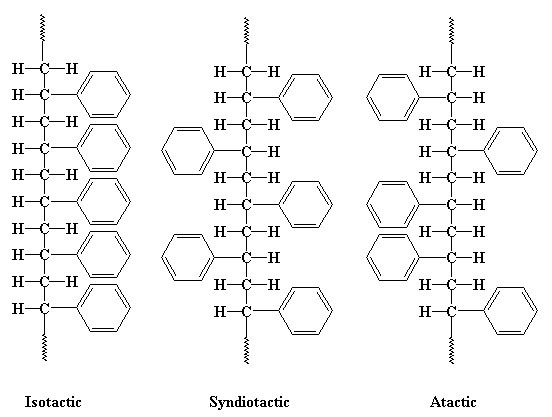
Polystyrene can have 3 isomeric structures: - atactic, in which the position of the phenyl is oriented randomly along the carbon atoms of the chain; - syndiodactic, where the phenyl groups are regularly alternating onto the carbon atom chain; - Isotactic, where the methyl groups are arranged on the same side.
It had better to have a graphic comparison.
3)Select one of the isomeric structures above and discuss the polymerisation process to ensure that the discussed structure is prepared.
Polymerisations which use Ziegler-Natta catalysts allow formation of the wanted isomer. Dependently by the chosen catalyst system, we could obtain only one isomer among the possible ones.

I chosen the simplest exercise, but there are some very difficult to solve! More or less, the difficulty of the italian exams is the same, perhaps in the italian ones there are much more calculate to do. In order to pass an exam, in Italy you have to cope firstly with the written task and then, if you have pass it, the oral examination.
Some exams are difficult to pass because of the professor: they reject students just for have said or done little mistakes. It happened to me as well.
I reckon I have to start to freshen up all my previous studies...

Reflections about Seminar 2

The second seminar has gone much better than the first one, from my point of view. Everyone have been involved into the discussion, which has been often vibrating. The researches done have been very useful: I have given some examples to support my idea and I have argued them when I was desagreeing with others. I have tried to move the discussion over all the other points, making connections when it has been possible.
I think my vocabulary and my fluency are improving, but I still need a little break sometimes when a word fails. :(
I have to start to build up more simple phrases and later articulate them with the right vocabulary. I should add two or more thinks easier that I do it now.
Perhaps because of the noise in the class and the distance between each other, I have had some problem to hear, I have lost few words but the phrase's mean has been clear.
It is possible to argue about the topic's pros and the cons for a whole life, because of the vastness of the theme, and the conclusions could be ever argued. However, most important aspect pools everyone, such as privacy and personal security.
We are everytime under control!

Sunday, November 30, 2008

Approach to Seminar 2

Tomorrow there will be the second seminar in which we will discuss about Crime and Science. I am looking out on lots of websites, most of them on BBC. Here there are some interesting reflections about privacy.
For each of the point it will examine, I am separating the pros and the cons. I am reading news happened in UK there are some unbelievables such as that one! How can money be wasted in that way... I don't know!
All seem going around databases which hold everyone's data! With them it can be possible prevent all crimes! And from the crime of stealing data, who or what protect us? Are those hedge in safe?
There is a fine line between lawful and illecit which very often, flowing into privacy violation.
See you later!

Thursday, November 27, 2008

We live in a world in which we are dangerously influenced by media images. To what do you agree with this statement?

Images. We live in a world surrounded by images, video, figures, photographs and illustration and, whether you like it or not, we are influenced and touched by them. Without images, televison and movies would not exist, even newspapers and tabloids could not be the same.
Since the advent of photograph, the amount of pictures has been increasing sharply: today, they are everywhere.
Most of the times, images are easy to 'read' and pervious because their immediacy and simplicity. For example, J.Francis David (2002), a media education specialist, says that "Images are so compelling, seductive, convincing and absorbing that we cannot not watch them. They give us pleasure, working best when they are emotionally saturated".
Besides lots of great images, which give us nice sensations, good feeling and percepts, there are others that turn out to be absolutely negative for the viewers' eye, such as violence, crimes, alcohol weapons, drug and more. Other kind of images may be deceptives, illusories and devious, which trick people, making their mind confused.
Firstly, this essay will examine just the negative sides of the media images, how they work in our brain and how that is influenced dangerously by them over all. It will see, also, the huge power of images into the advertising world and how publicity conditions the life of people. A further sight will be given to find out some criteria helping to analyse the contents in depht in order to pick only the right message and get rid of superficiality.
I quite agree with the topic: we live in a world where the media images are our culture and, if they are dangerous or badly interpreted, people are ready to emulate them. As the proverb says: 'All that glitter is not gold!'

Outlines:

  • Introduction to the world of images.
  • Paragraph 1: negative aspects and influence of images.
  • Paragraph 2: How advertising images can influence people's life.
  • Paragraph 3: Analysis of the contents: chosing only the right messages from images.
  • Conclusion: media literacy could be the solution to dispose of the bad sides.

Monday, November 24, 2008

Seminar 1

Here we go again!
Today there has been seminar about media literacy. Other 4 people and I have discussed over television viewing habits in our countries, television images and the future for television and television viewers.
I reckon my self-study of researches, lectures and listenings has been profitable in the today's seminar. We have started to speak one after the other in the beginning of our conversation: I have talked when was my turn and listened carefully the others opinion, giving support to the person I was agreeing with and motiving my objections for issues I was desagreeing with. I have tryied to explain my opinions as clear as possible, trying to use the right english pronuciation. The crucial thing I blame on me is my fluency and my language ease: This is not a problem related to the lack of words but just to the practice itself.
I think my group and I have gone on very well into our conversation, touching most of the points, moving towards all the topic.
In my opinion, that kind of experiences are very constructive and useful; it can "taste" how the work has been done altogheter, in order to fill the gaps.

Thursday, November 20, 2008

Reith 2006 - Daniel Barenboim

Daniel Barenboim is a Music Director, as well as great musician. He was born in a family of family of musician and, surrounded by music, he started to think in music too!
Helped by a piano, he explains in Berlin the power of the music, its neglect and disregard nowadays.
The director says that the foetus start to hear just after one month and an half; but after birth, all the concerns of the human beings shift on eyes and sight. These days, the ears are closed, we tend to do this because of noises, cars, also some music.
But music, which is close connected with silence, plays a very interesting role in our lives: it gives us the possibility of travel with the mind, living us in mid air. When we listen a note and after that a break, our brains start to think about the possible continuations of the piece. It made ambiguity: ambiguity means doubtful, plenty of solutions. But in music, "the longer you hold back on the solution, the more interesting the whole thing become".
Carrying on the conversation, Barenboim plays some useful shot examples you may found here.
Nowadays, many factors influence negatively the music and also the way how playing classic music by nationals orchestra. Globalisation, cosmopolitalism are hiding the way of how music is should be played. There is need to adapt the way of playing on the situation where it is played. Classic music can survive only whether become essential in our life, we have to learn FROM it.
We go on in our life standing with things of the past. Music is one of those. "Music of today could not have been created and therefore cannot exist without the music of the past", says Barenboim. Everything, without any exception, have a life, everything flows. Music teach us about fluidity of life and nothing is completely fixed.

Italian TV

This morning, we have had a little conversation about how television in our country works.
In Italy there are three State's channels, other three privates which belong to Berlusconi and an ocean of local networks. Since Berlusconi is also Prime Minister and, seeing that the Television Guarantor is nominated by the Parlament, therefore he controls everything! :)
In order to watch the firsts three, it need to pay an annual subscription, but the rest of the channels are free, because there are mountains of pubblicity!
Talking with my classmates, the italian programme schedule is not as different as in other countries. There are commercial breaks, spots and all kinds of advertisments. The news are frequently broadcasted. All day long, it may watch different programmes, for all the ages: mainly in the morning some issue for childrens or breakfast TV; in the afternoon soap operas, talk shows and series. From 21:00, "first evening" starts, and it goes on either films or documentary or entertainment shows depending on the chosen channel. Once a year, the Big Brother goes on the air, as other realityrubbish show well!
Every TV-program is watched by guarantor before going off: censorship have a good significance in Italy. It checks and controls the contains' programme. Two lampoon-politic talk show closed mouths because of "being too explicit", and another politic talkshow because criticised the Govern... Unbelievable!
The quality of the italian televison is not as high as those in other countries such as UK. In England you can watch just five channels, but in them, you could see something interesting: there are more educational programmes then in Italy, more news, more films, more or less the same ones reality show, and, at the end, but not last for relevance, less advertisment spots!!!
I hope it changes something in the italian television. I think it needs innovation, new programmes, new presenters, new showmen and showwomen, a new way of interact with the TV, in active way.

Wednesday, November 19, 2008

London Visit - Greenwich

During my spare time, I'm used to going around looking for some enchanting sights of London. For sure, one of those is Greenwich Park.


Greenwich Park is one of the vaster Royal Park of London. It is located on the south bank of Thames River. I was impressed with how big it was! You can see green all around you. There are huge lawns, lots of trees and bushes, gray squirrels which have no fear about people around. There are tiny street throughout the park where people jog, run, ride bikes or just relax theirselves sitting on benches.
Approximately in the center of the park, there is a knoll and, on the top of it, the Royal Observatory. Through the building passes the Prime Meridiane: this is the benchmark for measure the longitude.

In the museum,some animations teach about the universe's birth; other posters and screens show solar system, planets, galaxy and all about space. Who is keen on this matter must go! :)
I leave you here in order to tempt anyone to visit Greenwich Park and all its great beauty.
There are plenty on things to say about that place, you could find out on your own. Here are some sources:

http://www.royalparks.org.uk/parks/greenwich_park/
http://en.wikipedia.org/wiki/Greenwich
http://en.wikipedia.org/wiki/Prime_Meridian


Monday, November 17, 2008